
AE2 version and loader
Applied Energistics 2 stores items and fluids in an ME network, accessed through searchable terminals. You can connect external inventories and later request recipes through autocrafting.
This guide covers Minecraft 1.21.1, AE2 19.2.18 on NeoForge. The official download matrix lists loaders separately for each Minecraft version: 1.21.1 has no official Fabric download; older releases such as 1.20.1 do. Follow the matching version of the AE2 player guide, and check modpack recipes with JEI.
Quick start: meteorites, quartz and processors
- Find a meteorite, or put a vanilla Compass in a Charger to make a Meteorite Compass. Power the Charger from its top or bottom; a Wooden Crank works before you have a generator. The Charger reference explains both operations.
- Mine into the meteorite and break its Mysterious Cube to obtain all four Inscriber Presses. Harvest fully grown Certus Quartz clusters for crystals.
- Leave Flawless Budding Certus in place: breaking it degrades it even with Silk Touch. Lesser budding blocks can be moved with Silk Touch; they eventually degrade while growing. The budding quartz guide explains repairs and Growth Accelerators.
- Charge Certus Quartz in the Charger. Drop Charged Certus Quartz, Nether Quartz and Redstone into water to make Fluix Crystals.
- Use an Inscriber and the presses to make printed circuits and processors. Check each recipe's slots and inputs before automating it.
Once processors are available, build storage before attempting a large autocrafting system.
Build a working ME network
Gather an Energy Acceptor, an ME Drive, at least one ME Item Storage Cell, a Terminal and some glass, covered or smart cable. Empty drives provide no storage capacity.
Connect a power source to the Energy Acceptor, join it to the drive with cable and mount the terminal on ordinary cable. Insert the item cell into a drive slot, then test depositing and withdrawing one item. An ME Crafting Terminal adds a manual crafting grid. An AE2 Energy Cell is a useful buffer for bursts of network activity.
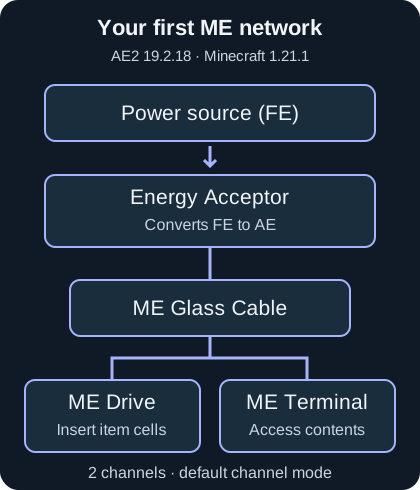
Starter network schematic. The drive and terminal use two channels in the default channel mode; an ME Controller is unnecessary at this size.
For Mekanism machines, an Import Bus collects outputs and an Export Bus supplies inputs. A Storage Bus exposes an external inventory.
Storage limits and channel troubleshooting
Standard item cells hold 63 item types. Larger cells increase bytes, while that type limit stays the same. Distinct damage or enchantments can make equipment count as separate types.
| Item cell | Bytes | Maximum types |
|---|---|---|
| 1k | 1,024 | 63 |
| 4k | 4,096 | 63 |
| 16k | 16,384 | 63 |
| 64k | 65,536 | 63 |
| 256k | 262,144 | 63 |
Each type reserves some bytes, so capacity depends on your mix of items. Keep damaged mob-farm equipment out of general storage. A Storage Bus on Storage Drawers can serve bulk items. See bytes and types for exact capacities.
With default channel settings, a controller-free network supports eight channel-using devices total. Adding a ninth shuts those devices down. With an ME Controller, normal cable passes eight channels and dense cable passes 32; a normal cable segment can bottleneck a larger branch. Smart cable shows usage. Packs can change channel limits.
If a powered terminal refuses items, check free types and bytes in the installed cells. If it goes offline, check power and channels. Repeated reboots during bulk deposits can indicate a small energy buffer; add an Energy Cell.
First autocrafting setup
Encode a crafting-table recipe in a Pattern Encoding Terminal, place the pattern in a Pattern Provider beside a Molecular Assembler, and connect a Crafting CPU containing Crafting Storage. Request the result from your terminal.
For a processing pattern, send ingredients from a provider to the machine and return its output to the ME network, for example through an Import Bus or into the provider. A chest exposed by a Storage Bus alone does not report the required crafting return. If a job waits forever, check that return path and that the pattern's output matches the real recipe. The official autocrafting guide covers CPU sizing and processing patterns.
Applied Energistics 2 FAQ
Does AE2 1.21.1 support Fabric?
The official 1.21.1 download is for NeoForge. Fabric builds exist for selected older versions, including 1.20.1. Match both Minecraft version and loader in the official download matrix.
Why can I open my ME Terminal but not store items?
Install an ME Item Storage Cell in the connected drive, then check its free bytes and item types. An empty drive cannot store anything. Also check cell partitions if only some items are rejected.
Do I need an ME Controller for my first network?
A network with up to eight channel-using devices works without a controller in default channel mode. A drive and a terminal consume two channels. Modified channel settings can change the limit.